For cars, patio furniture and light deck cleaning, the makers recommend a 1,300–2,000 PSI electric washer. For concrete driveways, they point to roughly 2,000–2,800 PSI, with heavy jobs above that, which is gas territory. Siding falls in between. Whatever the PSI, the nozzle and how far away you hold it decide whether you clean the surface or damage it.
What PSI Do the Makers Give for Each Surface?
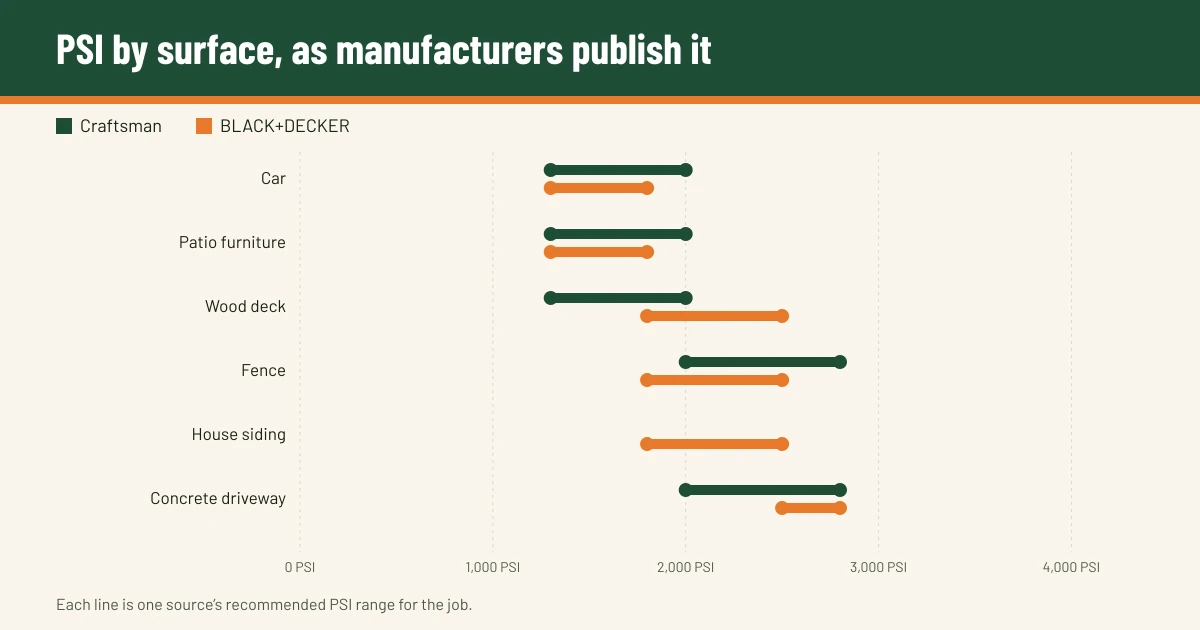
There’s no industry standard here, and the brands don’t fully agree. So each source’s figures are shown separately instead of averaging them:
Read these as the washer’s PSI rating class for the job, not the pressure that reaches the surface. That depends on the nozzle and distance. Two patterns hold across the sources:
- Cars, outdoor furniture and other delicate jobs sit at about 1,300–2,000 PSI. On cars, Greenworks advises the delicate setting, “about 2,000 PSI or less”, at a safe distance.
- Concrete driveways start around 2,000–2,500 PSI. Heavy concrete cleaning and paint stripping climb to 2,800–4,000 PSI. Craftsman puts heavy-duty jobs such as stripping paint or cleaning concrete at 2,800 to 4,000 PSI. BLACK+DECKER puts driveways and stubborn stains at 2,500 to 2,800 PSI.
Electric or Gas?
Six current models show the split. The electrics from Sun Joe, Greenworks and Kärcher list 1,800–2,030 PSI and 1.2 GPM. The gas models from Simpson, Craftsman and Generac list 3,100 PSI and 2.3–2.8 GPM.
PSI is the force of the water. GPM is how much water flows. Higher flow rinses loosened dirt away faster. That is why the gas machines, at roughly double the flow, finish big concrete areas sooner. Makers label these figures in different ways. Some state a “maximum” and some a “rated” figure, and a few state just a number.
Electric suits cars, decks, furniture and occasional siding, for owners who’d rather skip engine care. Gas suits a long driveway, heavy staining or paint prep, for owners fine with roughly 25–50 lb of extra weight. Those three gas models list 54–68.5 lb, and the electrics 20.7–27.7 lb.
Three Common Jobs, Worked Through
The ranges only help once they’re matched to real jobs. Here is how the published figures play out for the machines on this page:
- Washing a car and patio furniture. Greenworks advises about 2,000 PSI or less on cars. All three electric washers here sit at or near that figure, so any of them covers the job. The extra power of a gas machine adds nothing useful.
- A wood deck and a fence, a few times a year. These sit in the delicate-to-medium part of the chart. An electric washer can reach the figures the makers give. But the tip and distance matter more than the rating, so start wide and test a small area first.
- A long concrete driveway. Craftsman says sidewalks, driveways and fences need 2,000 to 2,800 PSI, and heavy-duty work 2,800–4,000 PSI. The gas models here, at 3,100 PSI and 2.3–2.8 GPM, cover both classes. An electric at 1.2 GPM can still clean concrete, more slowly.
How Do PSI and GPM Work Together?
Two machines with the same PSI can finish a job at very different speeds. PSI loosens dirt, and GPM carries it away. On this page, the gas models deliver about twice the water of the electrics. So a large flat area goes faster on gas, even if the pressure it needs is well inside what an electric can produce.
It helps to compare both figures rather than PSI alone. Check too whether each number is stated as “maximum” or “rated”. The makers don’t label them the same way, and a maximum isn’t a fair match for a rated figure. When the jobs fall in different classes, size for the hardest job done often. Then use a wider tip on the gentle ones rather than a second machine.
Why Does the Nozzle Matter as Much as the PSI?
The same machine can be gentle or harmful depending on the tip:
- 0° (red) is a pinpoint jet. Simpson’s manual keeps the red tip for unpainted metal and concrete and says “DO NOT use on wood.” Craftsman warns that the 0-degree nozzle “can also damage surfaces or cause injury if used improperly”.
- 25° (green) is for general cleaning. Sun Joe’s SPX3000 manual lists it for home siding, brick patios, wood decks, driveways and sidewalks. It says to test a small area first.
- 40° (white) is the widest and gentlest. Simpson lists the white tip for cars, trucks, RVs, wood, painted surfaces and vinyl siding.
Gas washers with a pressure control widen the range one machine can cover. Generac’s OneWash spec sheet lists it at 2,000–3,100 PSI, with a PowerDial to “Adjust the spray intensity.”
Pressure washer spray can inject water through skin. Simpson, Sun Joe and Generac all warn never to aim the spray at people or animals. Simpson’s manual says “DO NOT TREAT FLUID INJECTION AS A SIMPLE CUT! See a physician immediately!” Sun Joe’s manual says “In case of skin penetration, seek medical aid immediately.” Generac’s manual says “Do not aim spray gun at people, animals.”
How Do You Match PSI to Your Jobs?
- List the jobs you’ll do most often, not the one big job you might do once.
- Find the highest PSI range among those jobs in the table above.
- The washer needs to reach it. For mostly delicate jobs, it also needs a 40° tip.
- Check hose length against your space. The models above ship with 20–30 ft hoses.
For mowing limits on hills, see the slope guide.
Sources
All of these pages were read on November 7, 2026.
- Greenworks, Pressure washer uses
- Craftsman, Pressure washers: frequently asked questions
- BLACK+DECKER, What PSI pressure washer is best for home use?
- Simpson, MegaShot pressure washer operator’s manual
- Sun Joe, SPX3000 operator’s manual
- Generac, OneWash 3100 PSI pressure washer spec sheet and G0066021 owner’s manual