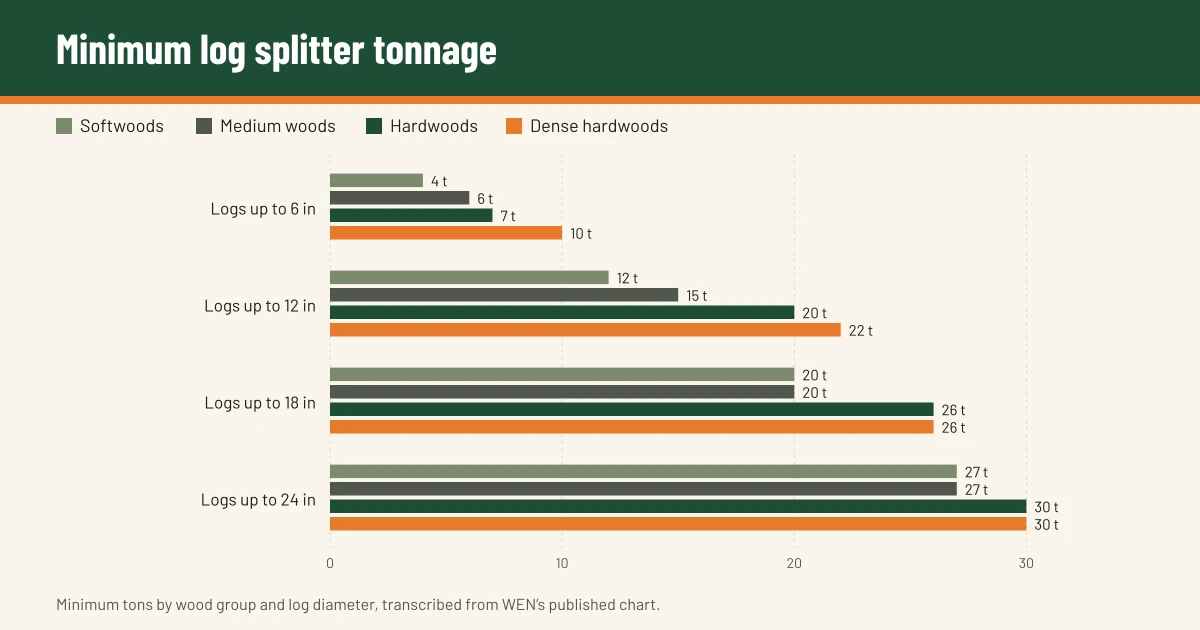
The bigger and harder the logs, the more tons you need. WEN’s chart puts 12-inch oak or hickory at 22 tons or more, and 12-inch white pine at 12 or more. For 12–18 inch hardwood rounds, WEN’s chart lands at 20–26 tons or more. Before you compare tonnage, check that the splitter’s maximum log length fits the length you cut your firewood to.
How Many Tons for Each Wood and Diameter?
WEN publishes a chart that pairs wood hardness (Janka rating) with log diameter. Pick your wood and largest log here:
The full table:
Two patterns stand out. Diameter matters more than species at the big end: by 24 inches, every wood group on WEN’s chart calls for 27 tons or more. Hardness matters most for mid-size logs: at 12 inches, dense hardwoods need almost twice the force of softwoods.
Three Worked Examples
WEN’s rule for a log between two rows is to “use the higher number”. That makes the chart easy to apply:
- 10-inch white pine. Ten inches falls between the 6 and 12-inch rows, so use 12 inches: 12 tons or more. The 16-ton Boss electric covers it, if the logs are short enough for its 20.5-inch limit.
- 14-inch oak. Fourteen inches falls between 12 and 18, so use 18 inches: 26 tons or more. The 20-ton Champion falls short of the chart here, and the 27-ton Champion and 34-ton DR both clear it.
- 24-inch hickory. This is the top row for dense hardwood: 30 tons or more. Of the four models on this page, only the 34-ton DR reaches it.
Size to the biggest rounds that come up often, not the single largest log in the pile. An unusually large round can be cut down with a saw first.
What Should You Measure at the Woodpile?
Four numbers settle most of this decision, and all of them can be measured at the woodpile:
- Species. Find it on the chart, or use the Janka rating if the species isn’t listed.
- Diameter. Measure across the largest regular rounds, then round up to the next row.
- Length. Check the length of the firewood against the splitter’s stated maximum.
- Weight. Lifting a big round onto a horizontal beam is hard work. Champion’s 201549 manual gives a 100 lb maximum log weight. If rounds are heavier, a splitter that also works upright saves the lift.
What Do Other Makers Advise?
Not every maker frames it the same way:
- Woodland Mills says “Around 18 tons is typically sufficient for most landowners processing common firewood”. It adds that 18 tons and more suits large or dense wood. Note that it sells an 18-ton splitter.
- Forest Master, a maker of small electric splitters, calls the idea that bigger logs need a stronger splitter “a fallacy”. In one reply it suggests “upwards of 7-ton” for seasoned beech about 30 cm (11.8 in) across.
The disagreement is real. WEN’s chart is the most conservative, so sizing to it leaves margin.
What Does Each Tonnage Class Cover?
Four current splitters show how WEN’s chart maps onto real machines:
- Boss Industrial ED16T21 (16 tons, electric): a 120 V electric splitter for softwoods and smaller hardwood rounds. Boss states it needs a 20 A circuit breaker.
- Champion 201549 (20 tons): covers WEN’s figures for 12-inch hardwoods.
- Champion 201518 (27 tons): covers 18-inch dense hardwoods on WEN’s chart. Champion lists its operating position as horizontal or vertical. Vertical mode means you don’t have to lift heavy rounds onto the beam.
- DR PRO XL34T (34 tons): covers every row of WEN’s chart and lists a 30-inch maximum log diameter.
Champion and Boss don’t publish a maximum log diameter (shown as a dash). Champion’s 201549 manual gives a 100 lb maximum log weight instead.
Gas or Electric?
The power source shapes where and how you split:
- Electric splitters like the Boss ED16T21 run from a household outlet. Boss lists a 120 V, 15 A motor and says a 20 A circuit breaker is required. So check the outlet’s circuit first, and have a licensed electrician add one if it falls short. They suit a garage or shed, and smaller rounds.
- Gas splitters carry their own engine, so they can work out at the woodpile and reach the higher tonnages. Champion lists a 212 cc engine on the 201549 and a 224 cc engine on the 201518. DR lists a 9.2 HP engine for the PRO XL34T. They also need the fuel and oil care their manuals describe.
If most of your wood is softwood or small-diameter hardwood, the electric option covers the low end of WEN’s chart. For big hardwood rounds, the tonnage you need points to gas.
Why Check Log Length First?
Tonnage gets the attention, but maximum log length decides whether your wood fits at all. The models above accept logs of 20.5–25 inches. If you cut 24-inch firewood, the Boss (20.5 in) won’t take it. Measure what goes in your stove before comparing tons.
What About Cycle Time and Orientation?
Cycle time is how long the ram takes to split and return. Makers state 11–16 seconds for the gas models here, though not always the same way. Some say average, and some don’t say whether it’s a round trip. A splitter that also works upright (the “both” in the table) is easier on your back with big rounds.
Follow the operator’s manual. Champion’s manual says “Always keep hands away from the wedge and the ram” and “Only one person should operate the log splitter and load the logs”. It also calls for safety glasses or goggles and heavy-duty gloves.
Clearing a sloped woodlot as well? Check your mower’s limits in the slope guide.
Sources
All of these pages were read on November 7, 2026.
- WEN, How to choose a log splitter
- Woodland Mills, What to consider when buying a log splitter
- Forest Master, Electric log splitter power
- Boss Industrial, 16 Ton Electric Dual Action Log Splitter (ED16T21) product page
- Champion, 201549 20-ton log splitter operator’s manual and 201518 27-ton log splitter product page
- DR Power, PRO XL34T horizontal-vertical log splitter product page