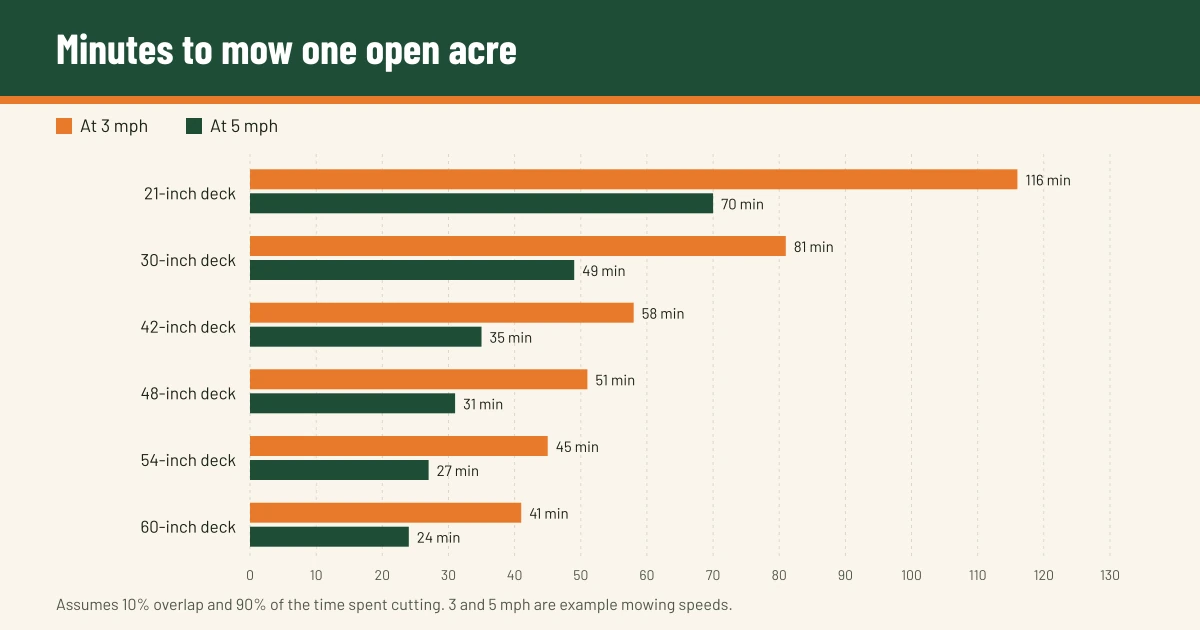
An acre takes about 44 minutes with a 42-inch deck at 4 mph on an open lawn. That allows 10% for overlap and 10% for turns. Add trees and beds, and the same mower needs about 52 minutes. A 21-inch walk-behind at a 3 mph walk needs close to 2 hours. The calculator below works it out for any yard.
The Formula
Farm advisers have used the same sum for decades. Iowa State University’s guide to field capacity gives it as width in feet times speed in mph, divided by 8.25. The answer is acres an hour. The 8.25 comes from 43,560 square feet in an acre divided by 5,280 feet in a mile.
That figure is the most a machine could ever cover. Iowa State then applies a field efficiency, which allows for “overlapping” and for “turning” and other delays. The calculator splits these into two inputs, so each one can be set on its own:
- Overlap: each pass covers a strip of the last one. The default of 10% is an assumption. It matches the battery vs gas guide.
- Layout: time lost to turns and edging. The defaults assume 90% of the time is spent cutting on an open lawn and 75% with trees and beds. Both are assumptions, not measured figures.
Together, the open-lawn defaults keep 81% of the full rate. That sits close to the 80% to 83% Iowa State lists for farm mower conditioners. Those are bigger machines on bigger fields, so treat it as a rough check only.
How to Measure the Lawn Area
Use the grass area, not the lot size. A one-acre lot with a house, a driveway and a patio may hold only two-thirds of an acre of lawn. Those parts aren’t mowed, so take them out first.
The simplest way is to split the lawn into rectangles. Pace or tape the length and width of each, multiply, and add them up. A lawn of 120 by 90 feet is 10,800 square feet, or about a quarter acre. Switch the area box to square feet and enter the total. For odd shapes, a rough sketch with three or four rectangles is close enough. A 10% error in area moves the time by 10%, and no more.
How to Find the Mowing Speed
Speed matters as much as width, and it is the input most often guessed. Iowa State’s method needs only a tape and a watch. Mark off 88 feet, drive it while mowing, and count the seconds. Then divide 60 by the seconds. At 12 seconds, the speed is 5 mph.
Don’t use the top speed from a spec sheet. Those figures are maximums:
| Mower | Deck | Top forward speed, as stated |
|---|---|---|
| Husqvarna TS 140X 42″ | 42 in | 5.2 mph (“Speed forward max”) |
| Husqvarna TS 140X 54″ | 54 in | 5.2 mph (“Speed forward max”) |
| Husqvarna Z254F | 54 in | 6.5 mph (“Speed forward max”) |
| Toro TimeCutter 42″ | 42 in | up to 7.0 mph (“Forward Ground/Transport Speed”) |
Toro’s own manual shows why the mowing speed is lower. The TimeCutter has three speed ranges. Toro lists its Trim speed as up to 5.5 mph and its Tow speed as up to 4.0 mph. The manual suggests Trim for heavy, wet grass and Tow for bagging and mulching. It also says “mowing at a slower ground speed can improve cut quality.” So the calculator starts at 4 mph, which is an assumption. Change it once the 88-foot pass has been timed.
Why Deck Width Matters Less Than Expected
A wider deck saves time, but less than its extra width suggests. Going from 42 to 54 inches makes the deck 29% wider. It cuts the time by 22%, because 42 divided by 54 is 0.78. On one open acre at 4 mph, that is about 44 minutes down to 34. The saving is 10 minutes a mow.
Driving 1 mph faster does nearly the same. The 42-inch deck at 5 mph takes about 35 minutes. So on a small lawn, speed and width trade almost one for one.
Three things eat into the gain from a wider deck:
- Turns: Iowa State notes that wider machines show “slightly lower field efficiency”, because turns at the ends take longer.
- Tight spots: a wide deck can’t fit between some trees and beds, so those strips need a trimmer or a second pass.
- Long grass: Toro’s manual says grass over 6 inches may need cutting twice. That doubles the time, whatever the deck.
Worked Examples
Each example uses 10% overlap. The first two are the checks used for the calculator.
| Yard | Deck and speed | Layout | Time per mow |
|---|---|---|---|
| 1 acre | 42 in at 4 mph | Open | about 44 min |
| 1 acre | 54 in at 4 mph | Open | about 34 min |
| 1 acre | 42 in at 4 mph | Trees and beds | about 52 min |
| 1/2 acre | 21 in at 3 mph | Open | about 58 min |
| 1/2 acre | 21 in at 3 mph | Trees and beds | about 70 min |
| 2 acres | 42 in at 4 mph | Open | about 1 h 27 min |
| 2 acres | 54 in at 4 mph | Open | about 1 h 8 min |
The half-acre rows run longer than the 52 minutes in the battery vs gas guide. That guide left turns out of its sum, and this one counts them.
For the first row, the sum runs like this. A 42-inch deck is 3.5 feet. At 4 mph, it covers 3.5 × 21,120 = 73,920 square feet an hour. Taking 10% off twice leaves 59,875. Then 43,560 ÷ 59,875 = 0.73 hours, or about 44 minutes.
What to Do With the Answer
The calculator shows three comparisons under the result. Each one points to a choice the owner can make:
- A wider deck or more speed. If both save only a few minutes a mow, the current mower is not the bottleneck. Time spent on edging and turns is a better target.
- A walk-behind against a rider. On half an acre, a 21-inch mower takes about an hour, so walking can be fine. On a full acre it takes close to 2 hours.
- A layout change. Trees and beds cost about 9 minutes an acre with a 42-inch deck. Mulching around trunks or joining small beds removes some of those turns.
Check It Against a Real Mow
The layout setting is the weakest input, so test it once. Time a full mow from the first pass to the last, leaving out breaks and emptying the bag. Then enter the same area, deck, speed and overlap. If the real mow took longer, switch to Trees and Beds. If it still runs long, the true speed is probably lower than the figure entered.
Iowa State describes the same check for farm machines. Divide the real rate by the full rate, and the result is the share of time spent cutting. Once the calculator matches one real mow, its answers for a new deck or speed are worth trusting.
The answer also helps with battery mowers. Compare the time per mow with the maker’s stated runtime, and leave a margin for thick spring grass.
Speed has limits on slopes too. Before driving faster on a hill, read the slope guide. For how deck and steering differ between mower types, see zero-turn vs lawn tractor and lawn tractor vs garden tractor.
Sources
All of these pages were read on November 7, 2026.
- Iowa State University Extension and Outreach, Estimating the Field Capacity of Farm Machines, PM 696 (Ag Decision Maker File A3-24)
- Husqvarna, TS 140X 42″ product page
- Husqvarna, TS 140X 54″ product page
- Husqvarna, Z254F Special Edition product page
- Toro, 42 in. TimeCutter (75742) product page and operator’s manual, Form 3449-212