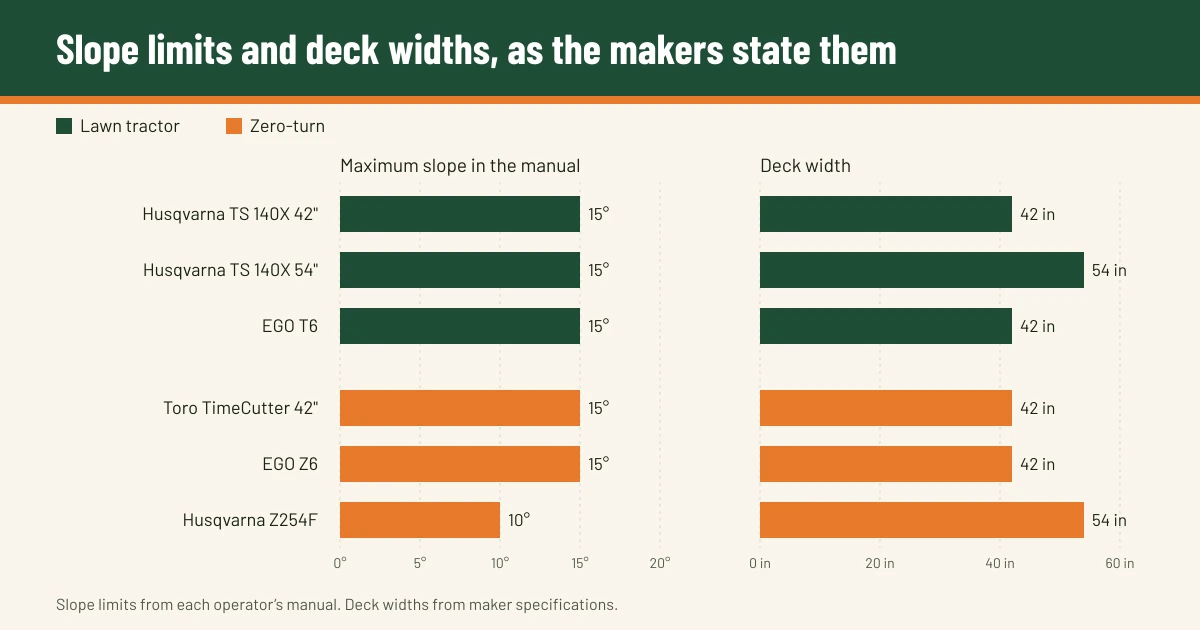
Zero turn vs lawn tractor comes down to the yard’s layout, its steepest slope and the work beyond mowing. A zero-turn pivots in place, which suits trees and beds. A lawn tractor steers with a wheel and often does more off-season work. On hills, five of six manuals allow 15°, including two zero-turns. One zero-turn stops at 10°.
How Does Each One Steer?
A zero-turn steers with its drive wheels. Husqvarna describes its system as “Individual, hydraulic wheel-drive” that “allows the mower to rotate around its own axis, without any turning radius.” CPSC puts it in plainer terms: the mower “can rotate 180 degrees and move away on the same path that it came in on.”
The controls are different too. On the Toro, the operator uses motion-control levers “to drive the machine forward, reverse, and turn either direction.” EGO’s Z6 manual says its levers “control the mower’s speed, direction, stopping (neutral position), and electronic brake (open position).”
A lawn tractor splits those jobs. On Husqvarna’s pedal-drive tractors, foot pedals set speed and direction, which keeps “both hands on the steering wheel.”
The line is starting to blur. EGO sells a zero-turn with a steering wheel and says it “Drives like a car, turns on a dime!”
Do Lawn Tractors Handle Hills Better Than Zero-Turns?
Not as a general rule. The limit belongs to the model, not the mower type, so the manual is the place to look.
Weights aren’t like for like. EGO’s exclude the batteries, and the TS 140X figures are with empty tanks. For the Z254F, the product page says 640 lbs and the manual says 590 lbs with empty tanks.
The wording in each manual:
- Husqvarna TS 140X 42″ and 54″ (lawn tractors): “Do not operate the product on ground that slopes more than 15°.” 42″ manual, 54″ manual
- EGO T6 (lawn tractor): “Do not mow slopes greater than 15 degrees.” T6 manual
- Toro TimeCutter 42″ (zero-turn): “Never operate on slopes greater than 15°.” Toro manual
- EGO Z6 (zero-turn): “Do not mow slopes greater than 15 degrees.” Z6 manual
- Husqvarna Z254F (zero-turn): “Do not operate the product on ground that slopes more than 10°.” Z254F manual
So EGO gives its tractor and its zero-turn the same limit, while Husqvarna’s zero-turn sits 5° below its tractors. Cub Cadet matches EGO. Its XT2 lawn tractor manual and Z1 zero-turn manual both say “Do not mow on slopes greater than 15° (25%).”
The makers’ descriptions show a further gap. The Z254F manual says it is “made to cut grass on open and level ground only.” The TS 140X manual allows “private garden slopes with not more than 15° slope.” Toro lists its zero-turn’s terrain type as “Flat with Obstacles”, despite its 15° limit.
Measuring a slope, converting degrees to percent grade and keeping clear of edges are all covered in the slope guide.
Do Zero-Turns Lose Steering on Slopes?
They can, and Toro says so directly. Its zero-turn manual warns that “Loss of traction to the drive wheels may result in sliding and a loss of braking and steering.” It adds, “The machine can slide even if the drive wheels are stopped.”
That fits the design Husqvarna describes. When the drive wheels do the steering, slipping tires affect both at once.
Lawn tractor manuals carry a warning too. EGO’s T6 manual says “Tires could slide even if the wheels are stopped”, the same line as its zero-turn manual. Cub Cadet’s tractor manual says “Do not operate tractor under any conditions where traction, steering, or stability is in question.”
None of these sources measures how much steering a tractor keeps when its tires slip.
CPSC’s fact sheet gives one set of slope rules for ride-on mowers, with no separate set for zero-turns. If the tires lose traction, it says to “disengage the blade(s) and proceed slowly straight down the slope.” It also warns against mowing wet grass, because “Tires may lose traction.”
Direction of travel differs too. CPSC, Husqvarna and EGO say to mow up and down. A decal printed in Toro’s manual says “only operate across slopes less than 15°”. Each owner should follow the manual for the exact mower.
Which Is Better Around Trees and Flower Beds?
The zero-turn’s pivot is the main advantage here. CPSC says it lets homeowners “mow close to landscaping and buildings.” Exmark, which sells zero-turns, says they “mow closer to landscaping, so you spend less time with the trimmer.”
Close work also tends to be slower work. Toro’s speed chart puts “Trimming grass” in its Trim range, which its product page lists at up to 5.5 mph.
Neither type replaces a trimmer everywhere. Toro asks operators to stay twice the machine’s width from drop-offs, ditches and water, and to use a walk-behind or hand trimmer in those strips.
Is a Zero-Turn Faster Than a Lawn Tractor?
On top speed, yes: each zero-turn here is rated faster than each tractor here. These are maximum forward speeds, not mowing times.
| Mower | Type | Steering | Maximum forward speed |
|---|---|---|---|
| Husqvarna TS 140X (42″ and 54″) | Lawn tractor | Wheel | 5.2 mph |
| EGO T6 | Lawn tractor | Wheel | up to 6 mph |
| Husqvarna Z254F | Zero-turn | Dual levers | 6.5 mph |
| Toro TimeCutter 42″ | Zero-turn | Dual levers | up to 7.0 mph |
| EGO Z6 | Zero-turn | Lap bars | up to 8 mph |
Only EGO calls its figures mowing speed. Toro’s 7.0 mph is labelled “Forward Ground/Transport Speed”.
These product pages state no time saved against a tractor. Exmark does, for a mower wider than any here. In 2015 it said a 60-inch zero-turn “can save an acreage owner with five acres more than 20 minutes in mowing time” against a similarly priced tractor. That is one seller’s estimate, and it doesn’t transfer to smaller decks.
Top speed also matters less on a slope. CPSC advises “a low ground speed so you will not have to stop or shift while on a slope.”
Which Takes More Attachments?
Both take some, and the tractors here tend to go further. Grasshopper, which builds zero-turns, says “You can add implements to zero-turn mowers, too.” It still calls attachment variety “one of the key benefits of a lawn tractor.”
Two brands that sell both types show the difference:
- Husqvarna: the TS 140X 42″ can take “a 42-inch two-stage snow thrower and a 48-inch snow blade”. The Z254F accessory list has a bagger, hitch kit, dump cart, aerator, dethatcher and sweeper, but no snow attachment.
- EGO: the T6 manual allows a towed cart of 600 lbs total rolling weight. The Z6 manual allows 250 lbs.
Attachments change the slope rules too:
- EGO: with the optional bagger, cargo box, sun shade or other accessories, the T6 and Z6 manuals both drop the limit to 10 degrees.
- Towing on slopes: the T6 manual says “Do not tow on inclines.” The Z6 manual says not to tow on inclines “more than 5 degrees / 9%”.
- Husqvarna: the Z254F and TS 140X manuals both rule out towing on slopes or rough ground.
For the difference between these machines and a heavier garden tractor, see lawn tractor vs garden tractor.
Which Yard Suits Which?
- Flat, with trees and beds: a zero-turn. This is the case Toro’s “Flat with Obstacles” label describes, and it rates the 42″ model for up to 2 acres.
- Open and flat: either. Deck width doesn’t separate the types, since both come in 42 and 54 inches. Husqvarna also puts its 42″ tractor at 1 to 2 acres.
- Slopes up to 10°: all six manuals allow it, though the Z254F’s stated use is level ground.
- Slopes from just over 10° to 15°: the Z254F is out. The other five manuals allow it, but Toro’s terrain label is a reason for caution.
- Steeper than 15°: none of the six. Toro’s manual marks that as a zone for a walk-behind mower or hand trimmer.
- Snow and hauling: a tractor, going by the Husqvarna and EGO limits above.
- Battery power: EGO’s T6 and Z6 are both rated at up to 1.5 acres per charge with six 6.0Ah batteries. The choice between them is mostly steering, towing and top speed. The electric riding mower guide has more.
Follow the exact mower’s manual on slopes and direction of travel. CPSC’s fact sheet also says the 2003 voluntary standard it describes, which stops the blades when backing up, excludes zero-turn machines. It advises against mowing in reverse “unless absolutely necessary” and to look “down and behind” before and while backing. CPSC fact sheet
Sources
All of these pages were read on November 6, 2026.
- U.S. Consumer Product Safety Commission, Riding Lawnmowers fact sheet, Publication 588
- Husqvarna, TS 140X 42″ product page and operator’s manual
- Husqvarna, TS 140X 54″ product page and operator’s manual
- Husqvarna, Z254F Special Edition product page and operator’s manual
- Husqvarna, About zero-turn lawn mowers and About riding lawn mowers
- Toro, 42 in. TimeCutter (75742) product page and operator’s manual, Form 3449-212
- EGO, POWER+ 42″ T6 Lawn Tractor product page and operator’s manual download
- EGO, POWER+ 42″ Z6 Zero Turn product page and operator’s manual download
- EGO, POWER+ 42″ Zero Turn with e-STEER product page
- Cub Cadet (MTD), Front Engine Lawn Tractor operator’s manual 769-26989A and Zero-Turn Tractor Lapbar Controls operator’s manual 769-27093
- Exmark, Zero Turn Mower vs Lawn Tractor: Which is better for you?
- Grasshopper, Is a zero-turn mower or lawn tractor best for you?