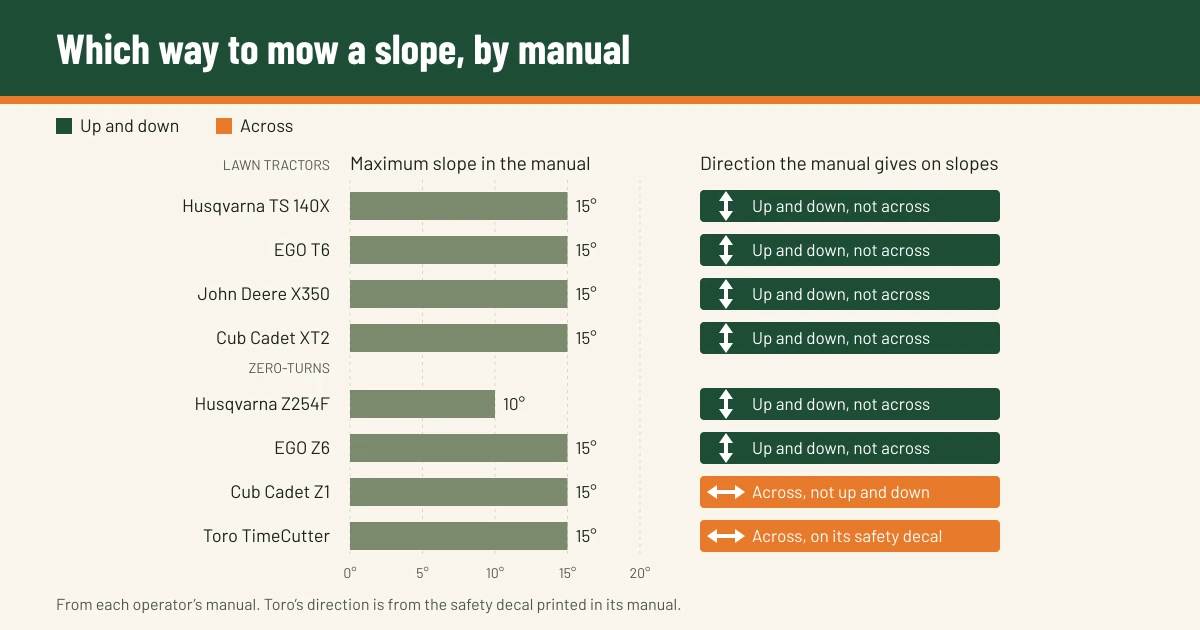
How to mow a slope on a riding mower depends on the mower’s own manual. Six of the eight manuals here say to mow up and down. Two zero-turn manuals say across. Most set the limit at 15°, and one sets it at 10°. Measure the slope, mow only on dry grass, drive slowly, and keep away from ditches and water.
Should You Mow Up and Down or Across?
It depends on the manual, not on the type of mower. Cub Cadet shows this best. Its lawn tractor manual says to mow up and down. Its zero-turn manual says the opposite.
| Manual | Type | Direction on slopes | Slope limit |
|---|---|---|---|
| Husqvarna TS 140X | Lawn tractor | “Cut up and down the slope, not from side to side.” | 15° |
| EGO T6 | Lawn tractor | “Mow up and down, not across the face of slopes.” | 15° |
| John Deere X330 to X394 | Lawn tractor | “Mow up and down slopes, not across.” | 15° |
| Cub Cadet front-engine tractor (XT2) | Lawn tractor | “Do not mow across slopes, only mow up and down slopes” | 15° (25%) |
| Husqvarna Z254F | Zero-turn | “Cut the grass on the slope up and down, not from side to side.” | 10° |
| EGO Z6 | Zero-turn | “Mow up and down, not across the face of slopes.” | 15° |
| Cub Cadet Ultima Z1 | Zero-turn | “Do not mow up or down slopes, only mow across slopes” | 15° (25%) |
| Toro TimeCutter 42″ | Zero-turn | Decal: “only operate across slopes less than 15°” | 15° |
Toro’s case needs a closer look. Its decal says to drive across. Its safety text gives no direction. It does warn that driving “on wet grass, across slopes, or downhill may cause the machine to lose traction.”
CPSC’s fact sheet gives the general rule: “Mow up and down slopes, not across.” Still, it lists “Read, understand, and follow all instructions on the machine and in the manual(s)” as its first rule. Where a manual and the general rule differ, the manual is for that machine.
None of these manuals says why it picks one direction. So a habit from an old mower can be the wrong habit on a new one.
How Steep Is Too Steep?
Most of these manuals stop at 15°. The Husqvarna Z254F stops at 10°.
John Deere’s riding lawn tractor brochure lists 18° for its X700 Signature Series, which includes the X730. That is a brochure figure, and a footnote says “Attachments may reduce Slope Operating Limit. See Operator’s Manual.” The same brochure lists 13° for the 100 and 200 Series. For more on these heavier machines, see lawn tractor vs garden tractor.
Attachments lower the limit in several manuals:
- EGO: with the bagger, cargo box, sun shade or other accessories, the T6 and Z6 manuals drop the limit to 10 degrees.
- John Deere: “When using attachments, never mow or operate the ride-on mower on slope angles greater than 10°.” Deere manual
- Cub Cadet: “Do not use grass catcher on slopes greater than 10° (17%).” XT2 manual
Limits are given in degrees, while hills are often given in percent grade. The two are not the same number.
| Slope angle | Percent grade | Rise over a 10 ft run |
|---|---|---|
| 10° | 17.6% | about 1.8 ft |
| 15° | 26.8% | about 2.7 ft |
| 18° | 32.5% | about 3.2 ft |
Grade is the tangent of the angle times 100. Cub Cadet’s manuals print 15° as 25%, which is a little under the exact figure.
Measure Your Slope
Measure the steepest part that will be mowed, not the average. Deere’s manual suggests laying a straight 4 ft board on the slope and reading it with an angle indicator. Toro, Husqvarna and EGO print a fold-out slope guide in their manuals.
The Back-Up Test
CPSC gives a simple check: “If you cannot back up the slope or if you feel uneasy on it, do not mow on it.” Both Cub Cadet manuals use nearly the same words.
Husqvarna’s version reads, “If you cannot reverse up a slope or if you do not feel safe, do not cut it.” EGO’s says, “If you feel uneasy on a slope, do not mow it.”
How Should You Drive, Turn and Stop?
CPSC lists the basics:
- Choose “a low ground speed so you will not have to stop or shift while on a slope.”
- “Avoid starting, stopping, or turning on a slope.”
- “Always keep the machine in gear when going down slopes. Do not shift to neutral and coast downhill.”
- “Do not try to stabilize the machine by putting your foot on the ground.”
If the tires slip, CPSC says to “disengage the blade(s) and proceed slowly straight down the slope.” The EGO and Deere manuals say the same.
Turns are another place where manuals differ. EGO says, “If turning is necessary, exercise extreme caution when changing direction and always turn downhill.” Cub Cadet’s tractor and zero-turn manuals say to “start at bottom and work upward to ensure turns are made uphill.” Again, follow the manual for the exact mower.
Is It Safe to Mow a Slope When the Grass Is Wet?
No. Every source here says not to. CPSC says “Do not mow on wet grass. Tires may lose traction.” EGO adds that wet grass can make tires slip on slopes “even though the brakes are functioning properly.”
Toro also warns that “The machine can slide even if the drive wheels are stopped.” It asks operators to judge “the site conditions of the day,” since moisture “can quickly affect the operation of the machine on a slope.”
How Far Should You Stay From Ditches and Water?
A slope inside the limit can still be unsafe near an edge. A wheel can drop over it, or the edge can give way. Each manual sets its own gap:
| Manual | Gap from drop-offs, ditches and water |
|---|---|
| Toro TimeCutter | “twice the width of the machine” |
| EGO T6 and Z6 | “at least two mowing widths (7 ft /2.13 m)” |
| Cub Cadet XT2 and Z1 | “at least 10 feet (3 meters)” |
| John Deere X330 to X394 | a buffer “at least as wide as the machine” |
| Husqvarna TS 140X | “Do not cut grass near edges, ditches or banks.” |
Toro and Deere both say to use a walk-behind mower or a trimmer in that strip.
Can You Tow on a Slope?
Only within the manual’s towing rules. Cub Cadet’s XT2 manual says “Do not tow on slopes greater than 5° (9%)” and caps loads at 250 lbs rolling weight. EGO’s T6 manual says “Do not tow on inclines.” Its Z6 manual sets the line at 5 degrees. The Z254F manual says “Do not tow on slopes or rough ground.”
Steeper Than the Limit
No manual here allows riding above its limit. Toro’s manual marks steeper ground as a “Danger Zone” and says to “use a walk-behind mower and/or a hand trimmer” there. A walk-behind mower has its own manual and its own slope rules. Ground cover in place of grass is another way to avoid mowing a bank at all.
How a mower steers also changes what happens when tires slip. The zero-turn vs lawn tractor guide covers that.
Read the slope section of the exact mower’s operator’s manual before mowing any slope. Direction of travel, turning and edge distances differ from one manual to the next. CPSC says slopes “are a major factor related to loss of control and tip-over accidents, which can result in severe injury or death.” CPSC fact sheet
Sources
All of these pages were read on November 7, 2026.
- U.S. Consumer Product Safety Commission, Riding Lawnmowers fact sheet, Publication 588
- Husqvarna, TS 140X 42″ operator’s manual
- Husqvarna, Z254F Special Edition operator’s manual
- EGO, POWER+ T6 lawn tractor operator’s manual download
- EGO, POWER+ Z6 zero turn operator’s manual download
- Toro, TimeCutter 42 in. (75742) operator’s manual, Form 3449-212
- John Deere, Operator’s Manual OMM174375, Select Series X330 to X394, “Operating on Slopes”
- John Deere, Riding Lawn Tractors brochure
- Cub Cadet (MTD), Front Engine Lawn Tractor operator’s manual 769-26989A and Zero-Turn Tractor Lapbar Controls operator’s manual 769-27093