
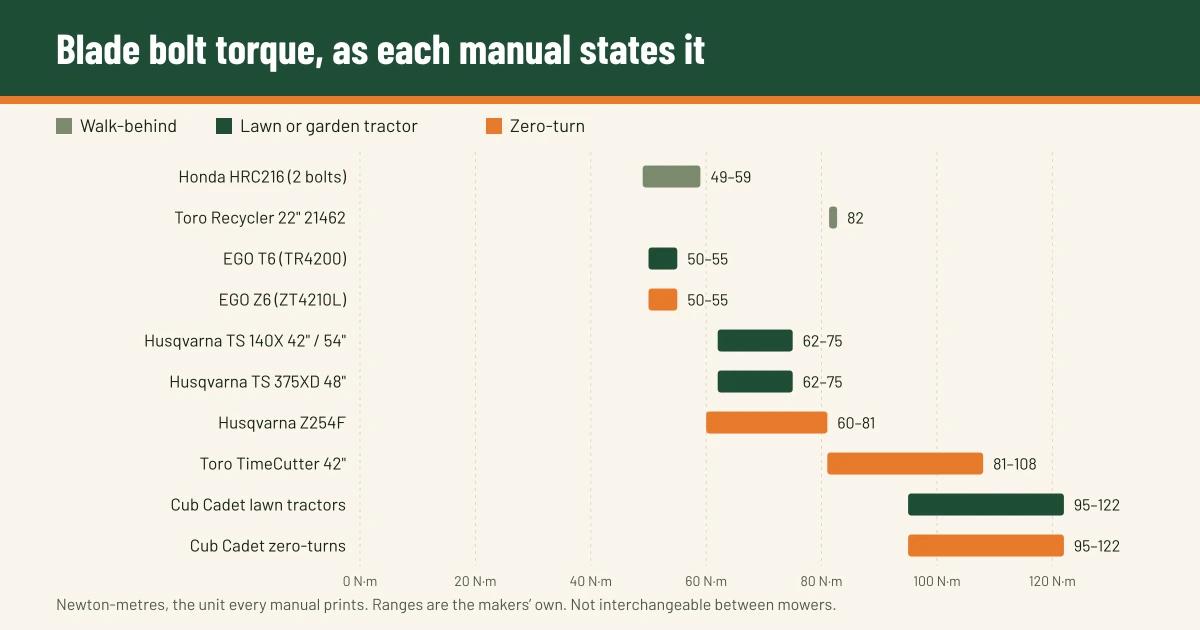
Lawn mower blades come in a few shapes, but the right one is the part your mower’s maker lists for it. Sharpen at the edge’s original angle, take the same amount of metal off each end, and check the balance. Then tighten the bolt to the figure in your manual. Across ten manuals, that figure runs from 49 to 122 N·m, so no single number fits every mower.
What Types of Mower Blades Are There?
Most blades are a flat bar with a sharp edge at each end. What changes is the back of the blade, called the sail or wing. It lifts the grass and throws clippings out.
Fisher Barton, which makes blades for mower brands, names four main types:
- High-lift: a steeper sail that “creates better suction and airflow.” It suits bagging, but not dusty or sandy ground.
- Standard: “a straight, basic design best suited for well-manicured lawns.”
- Low-lift: “less suction and airflow.” It suits dry, short or sandy lawns and raises less dust.
- Mulching: a curved blade with a wider cutting edge that cuts clippings finer. It can clog in tall grass.
Some mowers use two blades on one spindle. Honda’s HRC216 manual lists an upper and a lower blade and says to “install both blades as a set.”
How Do You Find the Right Blade?
Start with the model plate. Cub Cadet’s lawn tractor manual says to find it and write down the model and serial numbers. Some manuals list blade part numbers too. Honda’s does, on its parts page.
Then use the maker’s part. Husqvarna’s TS 140X manual says it is “dangerous to use a blade not approved by the manufacturer.” The Z254F manual warns that the wrong blade type “can cause objects to eject from the cutting deck.”
The center hole matters as much as the length. Husqvarna’s blade fits a star on the spindle. Cub Cadet uses a star, an S-shaped cutout or a click-in adapter, depending on the deck. A blade that looks close but doesn’t seat can come loose.
Blade Bolt Torque by Mower
This is the step people guess at most. The figures below are copied from each manual. They differ by more than double, so use the one for your own mower.
| Mower | Type | Blade fastening | Torque in the manual |
|---|---|---|---|
| Honda HRC216 | Walk-behind | Two bolts, upper and lower blade | 36–43 ft-lb (49–59 N·m) |
| Toro Recycler 22″ (21462) | Walk-behind | One bolt | 60 ft-lb (82 N·m) |
| EGO T6 (TR4200 manual) | Battery lawn tractor | Bolt, washer and flange | 36–41 ft-lb (50–55 N·m) |
| EGO Z6 (ZT4210L manual) | Battery zero-turn | Bolt, washer and flange | 36–41 ft-lb (50–55 N·m) |
| Husqvarna TS 140X 42″ and 54″ | Lawn tractor | Bolt, star on spindle | 45–55 ft-lb (62–75 N·m) |
| Husqvarna TS 375XD 48″ | Garden tractor | Bolt, star on spindle | 45–55 ft-lb (62–75 N·m) |
| Husqvarna Z254F | Zero-turn | Bolt | 60–81 N·m (no ft-lb given) |
| Toro TimeCutter 42″ (75742) | Zero-turn | Bolt and curved washer | 60–80 ft-lb (81–108 N·m) |
| Cub Cadet front-engine lawn tractors | Lawn tractor | Hex flange nut or hex nut | 70–90 ft-lb (95–122 N·m) |
| Cub Cadet lapbar zero-turns | Zero-turn | Hex nut | 70–90 ft-lb (95–122 N·m) |
Sources: Honda, Toro 21462, EGO T6, EGO Z6, Husqvarna TS 140X 42″ and 54″, TS 375XD, Z254F, Toro TimeCutter, Cub Cadet lawn tractors and zero-turns.
Toro’s walk-behind manual says plainly: “You will need a torque wrench to install the blade properly.” Honda says that without one, a dealer should tighten the bolts.
Before You Touch the Blade
- Stop it from starting. Toro says to shut off the engine, remove the key and disconnect the spark-plug wire. Husqvarna says to place the wire “where it cannot contact spark plug.” On EGO battery mowers, “always remove the safety key and battery packs.”
- Protect your hands. Toro, Husqvarna, EGO and Cub Cadet all say to wear heavy gloves or wrap the blade in rags. EGO also calls for eye protection when sharpening.
- Block the blade. Honda and Cub Cadet use a block of wood to stop it turning. EGO uses two metal rods in its stabilizer holes.
- Tip a walk-behind the right way. Toro’s Recycler goes on its side “with the air filter up.” Honda tilts the HRC216 to the right “so that the fuel cap side is up.” Sides differ, so check your manual. Toro also says to run the tank dry or pump the fuel out first.
- Riders: Cub Cadet and EGO have you take the deck off and flip it. Toro warns that on decks with more than one blade, “rotating one blade can cause other blades to rotate.”
How Do You Sharpen a Mower Blade?
- Check it first. Toro says to look at the curved area. If you see cracks, wear or a slot forming, fit a new blade at once. Never straighten or weld a blade.
- Clamp it. EGO secures the blade in a vise.
- File the edge. EGO says to use “a fine-tooth file or sharpening stone” and keep the original angle. Cub Cadet gives an angle of 25° to 30° for its blades. Other makers just say to match the original angle.
- Take off the same amount at each end. Toro notes the blade stays in balance “if the same amount of material is removed from both cutting edges.”
How often? EGO says twice a season “is usually sufficient,” and more often in sandy soil. Toro’s 21462 schedule says yearly, or sooner if the edge dulls quickly. Husqvarna’s Z254F manual says to let an approved service agent sharpen and balance blunt blades.
How Do You Balance a Mower Blade?
Hang the blade on its center hole. EGO uses a nail or round screwdriver shank clamped level. Toro and Cub Cadet use a blade balancer.
If one end drops, take metal off that heavy end. Toro says to file “the end of the sail area only,” not the cutting edge. Repeat until the blade stays level.
This step matters. Cub Cadet warns that a poorly balanced blade “will cause excessive vibration” and may damage the mower. EGO adds that it “could break.”
How Do You Replace a Mower Blade?
- Make the mower safe, as in the box above.
- Hold the blade with a wood block or the maker’s stabilizer. Remove the bolt or nut, washer and blade.
- Fit the new or sharpened blade the right way up. Toro says the curved part points up toward the deck. Cub Cadet says the side marked “Bottom” faces the ground. EGO prints “THIS SIDE FACING GRASS” on the blade.
- Line up the center hole with the star, S-shape or flange.
- Put back the washer in the order it came off. Toro’s TimeCutter washer goes cupped side toward the blade.
- Tighten to the torque in your manual, using the table above as a guide only.
Replace a blade that is bent, cracked or worn thin. Toro says to replace blades after hitting a solid object. If a new blade still measures more than 3 mm (1/8 inch) out, the spindle may be bent. On multi-blade decks, Toro advises replacing worn blades and bolts in sets.
When Is It Not the Blade?
Briggs & Stratton says that when a mower isn’t cutting well, “the blade might be dull or obstructed by debris.” It also says to clear clippings from under the deck. But a blade problem won’t stop the engine from starting. For that, see why a lawn mower won’t start. If a rider won’t crank, check the riding mower battery. For deck height and hills, the guide to mowing a slope on a riding mower quotes each maker’s limit.
Sources
All of these pages were read on November 7, 2026.
- Fisher Barton, Types of Lawn Mower Blades
- Honda, HRC216 lawn mower owner’s manual
- Toro, 22in Recycler 21462 operator’s manual, Form 3441-821 and TimeCutter 75742 operator’s manual, Form 3449-212
- EGO, T6 lawn tractor operator’s manual and Z6 zero-turn operator’s manual
- Husqvarna, operator’s manuals for the TS 140X 42″, TS 140X 54″, TS 375XD 48″ and Z254F
- Cub Cadet (MTD), Front Engine Lawn Tractor operator’s manual 769-26989A and Zero-Turn Tractor Lapbar Controls operator’s manual 769-27093
- Briggs & Stratton, 5 Mower Troubleshooting Tips